TOP 12 BIGGEST
MONEY MISCONCEPTIONS IN BANGLADESH
Bangladesh is growing and changing fast. We have a growing middle class, a digital-native generation, and more investment options than ever before. Yet, the beliefs most people hold about money haven't kept pace with that change.
At biniyog.io, we talk to investors every day. We hear the same myths repeated at family dinners, in office canteens, in social media posts. Some of these beliefs are harmless. Others are quietly destroying wealth that took you years to build.
This article is our honest attempt to address the most crucial ones among them to reduce the fear of Bangladeshi investors. Whether you earn ৳20,000 a month or ৳2,00,000, these misconceptions are costing you something.
28%
Financial Literacy in Bangladesh
10.05%
Inflation in 2025
-3%
Real return on investment
These three numbers alone should shake a few assumptions. Let's dig deeper. Sources:
Financial literacy in BD: https://thefinancialexpress.com.bd/views/views/strengthening-financial-literacy-in-bangladesh
Inflation in 2025: https://www.statista.com/statistics/438363/inflation-rate-in-bangladesh/
Real return on investment: https://www.tbsnews.net/economy/banking/inflation-weakening-taka-erode-savers-purchasing-power-1420066
1. “KEEPING MONEY IN THE BANK IS ALWAYS SAFE."
The Myth
"My money is in a fixed deposit/DPS/Shanchaypatra. It's earning interest and growing slowly. It's completely safe."
This is perhaps the most widespread financial belief in Bangladesh. The majority of Bangladeshi savers put their money in bank deposits or DPS or buy Shanchaypatra (saving certificates) and consider the matter settled. After all, the money grows a little each year so what could go wrong?
The problem is that "safe" is being measured in nominal taka, not in real purchasing power. And when inflation is running above your deposit rate, you are losing money every single day even while your bank balance technically grows.
The Reality
In 2025, the weighted average deposit interest rate across Bangladesh's banking system was approximately 6%, while the official average inflation rate hovered between 8–10% for most of that year. This means savers were earning less than the rise in their cost of living, effectively losing roughly ৳3,000 in real value for every ৳1,00,000 kept in the bank. Depositors who want to "play it safe" are actually watching their money silently erode. Even in the case of Sanchaypatra, the return is approximately 9.72-11.98%. While the maximum return from sanchaypatra could be more than the average inflation rate of 10%, the consideration of occasional 14.1% food inflation makes the return almost null. Sanchayapatra can be part of a portfolio, but it should not be the entire strategy, and its limitations like strict government regulations and non shariah-compliance must be clearly understood.
Sources:
Sanchaypatra data: https://rtvonline.com/english/amp/economy/271592
2024 July food inflation data: https://bangladesh.un.org/en/278828-bangladesh-market-monitor-july-2024
2. “I NEED LAKHS OF TAKA BEFORE I CAN START INVESTING.”
The Myth
"Investment is for rich people. Once I save up ৳5 lakh, then I'll think about it."
The waiting game is one of the most expensive mistakes a Bangladeshi investor can make. Many believe that investment requires a significant lump sum, the kind that feels out of reach on a regular salary. So they wait. And while they wait, inflation eats into their savings and compound growth is wasted.
The Reality
Platforms like biniyog.io allow you to start investing in SME businesses via Shariah-compliant contracts with as little as ৳5,000. The power of starting small and starting early is enormous. A person who invests ৳5,000 per month from age 25 will accumulate dramatically more by retirement than someone who invests ৳20,000 a month starting at 40. Even if the second person invests more total money. Time in the market is the most powerful variable, and it's available to everyone right now.
The belief that you need a large sum before investing doesn't come from financial logic, it comes from the old mental model that "investment" means buying land or stocks, both of which traditionally required significant capital. That world has changed
3. “IF I EARN MORE, I WILL AUTOMATICALLY BECOME WEALTHIER.”
The Myth
"My real problem is that my income is too low. Once I earn a higher salary, financial stress will disappear."
In Bangladesh, the aspiration to earn more is real and often necessary. But many people discover that earning significantly more doesn't resolve their financial stress, it just upgrades it. The car gets bigger. The apartment moves to a better neighborhood. Wedding spending escalates. Family pressure to help relatives intensifies.
The Reality
Wealth is the difference between what you earn and what you spend, not your income alone. A person earning ৳1,50,000 a month and saving ৳30,000 is building more wealth than someone earning ৳3,00,000 and spending ৳2,95,000. The discipline of spending less than you earn, regardless of your income level, is the actual foundation of financial security. Income growth is wonderful, but without a savings and investment habit, it gets consumed rather than compounded.
4. “WEALTHY PEOPLE ARE JUST LUCKY."
The Myth
"Those who are rich were born rich, got lucky, or did something shady. It has nothing to do with financial behavior."
This belief is especially damaging because it removes personal fault. If wealth is just luck, there's no point in trying to build it deliberately. This attitude that is common across income levels in Bangladesh, actually keeps people from making the disciplined financial decisions that create long-term security.
The Reality
While structural advantages are real and should be acknowledged, a large body of research on wealth accumulation shows that consistent behavior like regular saving, disciplined spending, patient long-term investing, and continuous financial education explains far more of the wealth gap than luck does. Many of Bangladesh's successful entrepreneurs came from modest backgrounds. The difference was not luck; it was a combination of discipline, risk tolerance, and financial habits formed over years. You may not control your starting point. But you control your savings rate, your investment consistency, and your financial literacy.
5. “DEBT IS NORMAL SINCE EVERYONE HAS IT.”
The Myth
"Taking loans from multiple sources, using credit cards at high interest, and owing money is just part of modern life. Everyone does it."
The normalization of debt is dangerous anywhere. In Bangladesh's context, it is particularly acute because consumer debt often involves informal lenders at extortionate rates, or credit card debt accumulating at rates that make it nearly impossible to escape. Yet because "everyone does it," people rarely question whether they should.
The Reality
Debt is not inherently bad; a business loan taken to grow a profitable enterprise can be a powerful wealth multiplier. But consumer debt taken to fund lifestyle spending is wealth destruction in disguise. In Islamic finance, the principle is clear: avoid unnecessary debt, live within your means, and do not take on obligations that chain your future income to servicing your past consumption. Every taka spent on interest payments is a taka that cannot compound for you. Building a culture of saving before spending rather than spending and scrambling can be the foundation of financial health.
6. “LAND AND GOLD ARE THE ONLY REAL INVESTMENTS."
The Myth
"Everything else is risky or uncertain. Buy land. Buy gold. That's what my parents did, and they were fine."
In Bangladesh, land and gold carry deep cultural weight. Land is tied to identity, legacy, and family honor. Gold is gifted at weddings, stored for emergencies, passed down generations. Both are tangible. You can touch them, show them, own them physically. This tangibility makes them feel safe in a way that other investments don't.
But there are serious blind spots in this thinking that most Bangladeshis overlook.
The Reality
Land in Bangladesh comes with high transaction costs. Registration fees alone can exceed 11% which is among the highest in South Asia. Lands are also illiquid as you can't sell part of a plot if you need emergency cash. Moreover, the legal risk is high as land disputes are among the most common court cases in Bangladesh. There is no income unless rented. Gold doesn't generate income at all. It simply holds or gains value.
Both are entirely concentration bets: they leave your wealth exposed to a single asset class with no diversification. Modern investing allows you to generate returns from actual economic activity, real businesses, and real revenue while also diversifying across multiple opportunities.
Sources:
Registration fee 11%: https://www.swadeshproperties.com/happening/blog/bangladesh-economic-growth-dhaka-land-prices
Negative aspects/challenges of land buying: https://starpathholdings.com/residential-land-investment-in-bangladesh/
7. “REMITTANCE FROM ABROAD IS BEST KEPT IN CASH AT HOME OR SENT THROUGH HUNDI."
The Myth
"The exchange rate is better through informal channels, and keeping cash at home means I can access it immediately."
Bangladesh is one of the world's largest recipients of remittances. $32.8 billion flowed into the country in 2025. A significant portion of this comes from the Middle East, Southeast Asia, and Europe. Yet a meaningful share of it moves through informal hundi networks or sits idle as cash.
The Reality
Cash kept at home earns nothing and is exposed to theft, loss, and - most significantly - inflation. Hundi is illegal under Bangladeshi law and denies the country's economy the official foreign exchange it needs. Meanwhile, formal remittance channels increasingly offer competitive rates, especially as Bangladesh Bank has taken steps to improve official channel competitiveness. More importantly, remittance money sitting idle is a missed opportunity. Bangladesh's remittance workers sacrifice enormously to send that money home. Putting it to work in halal, transparent investments honors that sacrifice far better than letting it lose value in a drawer.
Sources:
Remittance amount: https://www.thedailystar.net/business/news/highest-ever-remittance-came-2025-4070821
8. “RETIREMENT IS A DISTANT CONCERN, I WILL HANDLE IT LATER.”
The Myth
"I'm 30. Retirement is still 30 years away. I have plenty of time. My children will take care of me anyway."
Bangladesh has no universal pension system outside the government sector. The vast majority of private sector workers, self-employed individuals, and informal economy participants have no structured retirement savings at all. The plan, almost universally, is "my children will look after me."
The Reality
Relying entirely on children for retirement income puts both generations in a difficult position. The children carry a financial burden that may conflict with their own family needs, while the parent has no financial independence or dignity of choice. There is no guarantee that children will always outlive the parents either. More fundamentally, the power of compound growth means that decisions made at 30 have an exponentially larger impact on retirement wealth than decisions made at 50. A monthly investment of ৳5,000 starting at age 30 will grow to dramatically more by age 60 than double that amount starting at 45. Every year of delay is not one year lost, it is many years of compounding lost.
9. “THE HIGHEST ROI INVESTMENT IS AUTOMATICALLY THE BEST ONE”
The Myth
"If one option gives 12% and another gives 20%, the 20% option is obviously better. Why wouldn't I always choose the highest number?"
This is one of the most dangerous cognitive shortcuts in all of investing. It is particularly acute in Bangladesh, where a significant number of investors have been burned by pyramid schemes, fraudulent investment platforms, and unregistered MFIs promising extraordinary returns.
The Reality
Higher return always means higher risk. Always. This is not a coincidence or a policy; it is a mathematical reality of how markets work. A legitimate investment can offer you a good return for your level of risk. An illegitimate one can offer you any return it likes, because it has no obligation to actually generate it. Before chasing the highest number, ask: What is the actual business model generating this return? What happens if the investment fails? Is this entity regulated? Is this investment tied to a real business activity? Has the business been physically verified?
A moderate, verified, Shariah-compliant return from a real business that has been audited is worth far more than a dazzling number attached to nothing you can confirm.
10. “MANAGING MONEY IS A MAN’S RESPONSIBILITY"
The Myth
"Financial decisions are handled by the husband / father / brother. Women don't need to worry about the finances, someone else will take care of it."
This belief is deeply embedded in Bangladeshi culture across socioeconomic backgrounds. Women's financial autonomy is frequently disregarded, even when a woman earns significant income of her own. The result is that millions of Bangladeshi women have no independent financial footprint, no savings in their own name, and no fallback if family circumstances change.
The Reality
Financial literacy and investment are skills, not gender-linked abilities. Women in Bangladesh who earn income: whether through garment work, service sector employment, remittances, or entrepreneurship, deserve the same access to financial growth as anyone else. The government's own financial literacy programs reported that 169,554 of 461,948 people who received financial literacy training between 2023 and 2024 were women, a recognition that this gap is real and must be addressed. A woman with her own investments is more resilient, more independent, and better positioned to support her family regardless of what life brings.
Sources:
Financial literacy training data: https://thefinancialexpress.com.bd/views/views/financial-inclusion-driving-inclusive-growth
11. “FINANCIAL TIPS FROM SOCIAL MEDIA GROUPS ARE RELIABLE.”
The Myth
"My cousin's friend made 3x on this stock. It's trending in the group. Everyone's buying. I should get in before it's too late."
In Bangladesh's culture, social proof is enormously powerful. If your group says to buy, it feels reckless not to. This behaviour, amplified by social media platforms like Facebook, has been one of the primary drivers of speculation in the DSE and has been a central factor in a number of crashes.
The Reality
By the time a financial/investment tip reaches your group, the people who originated that tip have often already taken their profit. You are buying into an already-elevated price, and the manipulators are preparing to sell. The DSE explicitly warns investors not to rely just on social media for investment decisions and notes that spreading rumor-based information using DSE's name is a punishable offence under the Securities and Exchange Ordinance. Rumor-driven trading doesn't just harm individual investors, it undermines the entire market's credibility and efficiency.
12. “HALAL INVESTMENTS ARE COMPLETELY RISK FREE."
The Myth
"Since XYZ investment is halal and conforming to Shariah standards, my investment here is 100% safe."
We, from biniyog.io, hear this often, and we deeply appreciate the trust it reflects. But it's a belief we have to address honestly, because it can lead to uninformed decisions that aren't in your best interest.
The Reality
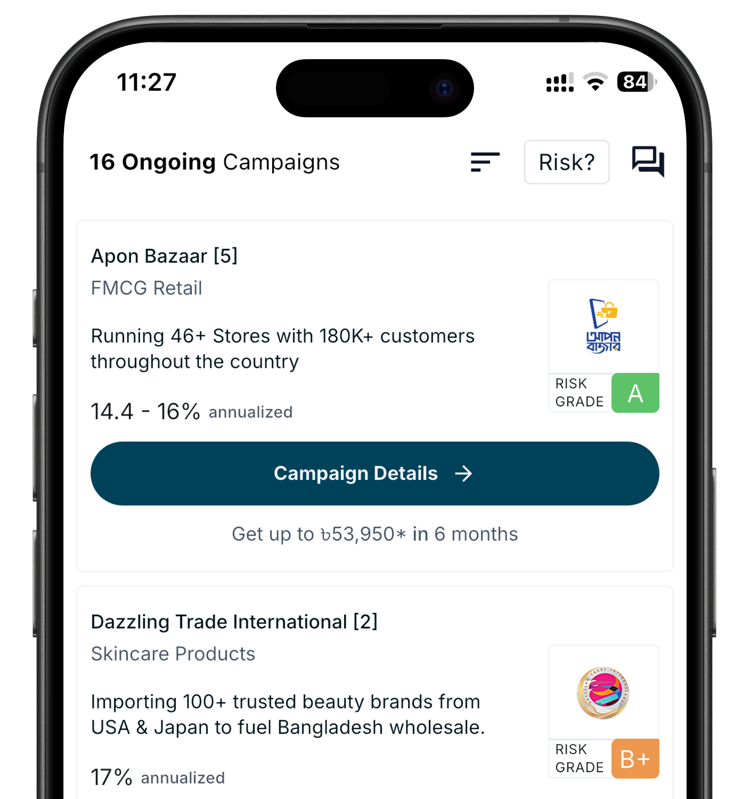
Halal means ethically permissible according to Islamic principles. It means the investment is free from Riba (interest), Gharar (excessive uncertainty), and Maysir (gambling). It means the business operates in a way that aligns with your values. What it does not mean is zero risk. Every investment in the world - stocks, real estate, business financing all carries some level of risk, because every business operates in a real economy subject to real market forces. A business owner may fall ill. A major customer may switch suppliers. A new regulation may affect the industry. At biniyog.io, we conduct thorough due diligence and assign risk grades (A, B+, B) to every campaign on our platform. But we will never promise guaranteed returns, because that promise would itself be dishonest.
Read about this in more detail here.
FINAL THOUGHTS
Beliefs about money are among the hardest to change, because they're not just intellectual; they're emotional, cultural, and deeply personal. Many of the misconceptions in this list were passed down from parents, reinforced by peers, and seemingly confirmed by lived experience. Challenging them is not easy.
But the cost of holding onto outdated beliefs is real. Bangladesh's inflation has averaged well above what most savings instruments return. The stock market has punished speculation while rewarding patience. The families who built wealth over generations were not lucky. They were disciplined, diversified, and willing to learn.
At biniyog.io, our mission is to make it possible to grow your wealth the halal way. Starting from ৳5,000, with full transparency, verified businesses, and Shariah-compliant structures. We exist because we believe more Bangladeshis deserve access to ethical, productive investments. Not just the wealthy. Everyone.
The next step is yours. Go through the campaign details. Read the contract details carefully. Understand the risk. Ask us your questions. And start where you are, with what you have.
Because informed investors make better decisions. And better decisions build better futures.
For any questions, leave us a message or contact our support.
Your financial well-being is our topmost priority & our team is always here to help. Visit biniyog.io or reach out to our support team.
DOWNLOAD OUR APP
Start your journey to wealth.
Our halal investments are structured in accordance with the strictest Islamic principles.


Office Level 5, House 60, Kazi Nazrul Islam Avenue, Dhaka 1215
Contact +880 1886 064 046


