

10 ISLAMIC PRINCIPLES
TO FOLLOW FOR YOUR FINANCIAL WELLBEING
Most of us have one of two separate perspectives about money. One comes from the media, from the people around us: “Earn more, save more, and try not to fall behind”. The other comes from home, from the masjid, from our parents reciting du'a before our new beginnings: “Rizq is from Allah, wealth is a trust, and barakah matters more than the balance on your bank”.
For a long time, these two things have felt like separate conversations. Bangladesh is one of the most religiously observant Muslim-majority countries in the world, and yet most of our daily financial habits about savings, debt, and long-term financial plans are shaped almost entirely by convention, not by conviction. We were never really taught how the two paths fit together. This blog tries to close that gap. It draws on the Yaqeen Institute's research paper, "Psychology of Wealth: An Islamic Perspective on Personal Finance" by Dr. Osman Umarji.
See as we try to reframe the core ideas of the paper in the context of how money actually moves through a Bangladeshi household in the form of DPS or any other traditional interest-based savings instrument contributions, Eid and wedding costs, gold savings, family obligations, and all. These principles are not a checklist to complete. They are a different lens to look through, one that was actually designed 1,400 years ago to correct exactly the kind of financial anxiety, comparison, and short-term thinking that shows up in our daily lives.
A note on our sources: This piece draws directly from Yaqeen Institute's paper "Psychology of Wealth: An Islamic Perspective on Personal Finance" (read it here), written by Dr. Osman Umarji. We've reorganized and reframed the core ideas specifically around Bangladeshi financial habits, with local data woven in throughout. We are not scholars. For detailed fiqh rulings, please consult a qualified Islamic scholar.
1. “WEALTH WAS NEVER YOURS TO BEGIN WITH."
This is one of the most quietly radical ideas in Islamic finance. Conventional economics says: “You earned it, it's yours, do whatever you want with it”. Islam says something completely different: “Allah is the true Owner of all wealth, and you are merely a trustee”.
"Believe in Allah and His Messenger and spend out of that of which He has made you trustees. For those who have believed among you and spent, there will be a great reward."
— Qur'an 57:7
Source: https://quran.com/en/al-hadid/7
A trustee doesn't get to spend recklessly, hoard endlessly, or use the trust however they please. They have to honor the terms of the trust. That’s why in Islam these principles including zakat, waqf, hima, inheritance law, moderation in spending, and a prohibition on hoarding, got significant emphasis.
In Bangladesh, we say "my taka" the same way anyone else would, and that's natural, Bangla doesn't have a different grammar for trusteeship. But the mindset shift matters in practice. It's the difference between a businessman who treats his profit purely as his personal property versus one who sets aside a fixed share for zakat, for his workers' welfare, and for his parents before deciding what's "left over" for himself
2. “SPENDING ON FAMILY COUNTS AS SADAQAH."
Here's something that should bring real comfort to a huge number of Bangladeshi households: the money you send home, the school fees you pay for your siblings, the medicine you buy for your parents and all the things you do for your family aren’t simply an obligation. If it’s done with the right intention, Islam views it as charity.
"If a Muslim spends on his family seeking reward from Allah, it is charity for him."
—Sahih al-Bukhari 5351; Sahih Muslim 1002
Source: https://sunnah.com/bukhari:5351
Bangladesh's remittance economy makes this principle especially relevant. Migrant workers abroad sent home a record amount in 2025, and a significant share of that money goes directly toward family food, education, healthcare, and especially around the Eid gifts and celebration costs.
The brothers sending money home every month isn't just fulfilling a duty. When their intention is to please Allah through it, they are actively building their akhirah portfolio. This doesn't erase the real, well-documented strain that long-term family separation and financial dependency can place on migrant households. But it does reframe the sacrifice: every taka sent with sincerity is not lost. It's invested.
3. “SPEND WITH MODERATION, NOT EXTREMES."
Islam draws a straight line between two extremes and asks us to walk down the middle: neither miserliness nor extravagance.
"And [they are] those who, when they spend, do so not excessively or sparingly but are ever, between that, justly moderate."
— Qur'an 25:67
Source: https://quran.com/en/al-furqan/67
This principle has a very specific resonance in Bangladesh, where two opposite financial cultures can even coexist in the same family. There's the extreme of hoarding where a person keeps gold in a locker for decades, never invests with a risk-sharing mindset, and keeps it as a backup "just in case". And then there's the extreme of overspending where budgets spiral well beyond what families can afford, often financed through high-interest informal loans, just to keep up with social expectations.
Wedding season is probably our culture's biggest test of this principle. The Prophet ﷺ said, "Eat, drink, give in charity, and wear nice clothing, but without pride and extravagance." A wedding can be beautiful and joyful without becoming a debt trap that the bride or groom's family spends the next three years repaying. Moderation here doesn't mean cheap; it means proportionate to what you actually have.
4. “WEALTH IS A TEST, NOT A TROPHY."
There's a quiet but persistent theological myth that shows up across cultures, including ours: that wealth is a sign of Allah's favor, and that poverty is a sign of His displeasure. The Qur'an directly corrects this.
"And as for man, when his Lord tests him and [thus] is generous to him and favors him, he says, 'My Lord has honored me.' But when He tests him and restricts his provision, he says, 'My Lord has humiliated me."
— Qur'an 89:15–16
The Qur'an then gives us the story of a man given immense wealth who grew arrogant, believed it was purely the result of his own brilliance, and was ultimately destroyed along with everything he had built. Some among his people had envied him, wishing for what he had, until they witnessed what his wealth actually was: a test he failed.
In Bangladesh, we have the tendency to treat wealthy businessmen, garment factory owners, or returning expatriates as automatically more honorable or more blessed. On the other hand, the tendency to view a struggling rickshaw-puller or day laborer as somehow less favored by Allah. Both readings are the exact theological myth the Qur'an warns against. "Indeed, the most honorable of you in the sight of Allah is the most righteous of you" (Qur'an 49:13) — not the wealthiest.
5. “RIZQ ISN’T SOMETHING YOU CHASE, IT’S SOMETHING YOU RECEIVE."
Rizq is sustenance provided by Allah SWT. It's both the means by which we provide for our families and a test of how we respond to having it, or not having it. The Qur'an describes human beings as having an exceptional love for wealth and the Prophet ﷺ warned that this love, left unchecked, can ruin a person the way it ruined nations before us.
"By Allah, it is not poverty I fear for you; rather, I fear you will be given the wealth of the world, just as it was given to those before you. You will compete for it just as they competed for it, and it will ruin you just as it ruined them."
— Sahih al-Bukhari 6425; Sahih Muslim 2961
Source: https://sunnah.com/bukhari:6425
In Bangladesh, we relentlessly compare even our happiest moments. Weddings, graduations, Eids, promotions, each needs to have a more grand celebration than those in our surroundings. "Who achieved more than you?" “Why can’t you be like them?” “Don’t I feed you the same food as them? Why aren’t you succeeding like them?” are usual conversations at family gatherings. A father works overtime in our nation to afford a flat in Bashundhara R/A not because he needs it, but because his brother-in-law has one. The principle of rizq doesn't tell us to stop working hard; the Prophet ﷺ himself said seeking lawful wealth is an obligation. It tells us to stop treating the chase itself as the source of our security.
6. “CHASING WORLDLY GAIN BREEDS ANXIETY, CHASING AKHIRAH BREEDS CONTENTMENT.”
One of the most repeated themes in the Prophet's ﷺ guidance on wealth is this paradox: the more obsessively you chase worldly gain as your central goal, the more anxious and unsettled you become. This remains true even if you succeed in achieving what you chased.
"Whoever is focused only on this world, Allah will confound his affairs and make him fear poverty constantly, and he will not get anything of this world except that which has been decreed for him. However, whoever is focused on the Hereafter, Allah will settle his affairs for him and make him feel content with his portion, and his provision and worldly gains will undoubtedly come to him."
— Sunan Ibn Majah 4105
Source: https://sunnah.com/ibnmajah:4105
This matches something Bangladesh's own financial behavior research keeps finding: financial anxiety isn't strictly correlated with income. Plenty of middle-income earners in Dhaka report chronic money stress, while some lower-income households with strong saving discipline report greater peace of mind. There is an endless cycle that many of us know too well: we work overtime for a promotion, get the promotion, immediately upgrade the flat, immediately feel the EMI pressure, immediately start chasing the next promotion to cover it. Each rung of the ladder resets our anxiety to the same level, just at a higher altitude. The principle here isn't "don't work hard"; rather, it's "don't let dunya be the finish line you're sprinting toward."
7. “IDLE MONEY HAS A BUILT-IN COST. ZAKAT PROVES IT.”
Here's a piece of Islamic financial logic that predates modern inflation theory by over a millennium. Umar ibn al-Khattab advised, "Invest the wealth of orphans so that it will not be eaten away by zakat." The reasoning: if money simply sits there, untouched, year after year, the 2.5% annual zakat obligation alone will erode it, entirely separate from inflation.
Source: https://www.dar-alifta.org/en/fatwa/details/6430/zakat-on-a-minors-property
If you have ৳10,00,000 sitting completely idle, it becomes ৳9,75,000 after zakat in year one. After ten years of doing absolutely nothing with it, it falls under ৳8,00,000, and that's before counting what inflation has done to its real purchasing power in the same period.
In our nation, gold and cash are kept in a locker or under the mattress, year after year, generation after generation, just to be safe. It's one of our most common savings habits, and it's also one of the clearest examples of what Umar ibn al-Khattab was warning us against. Islamic scholars in Bangladesh have also pointed out that public awareness of how to even calculate zakat on modern assets like stocks, mutual funds, SME investments, etc remains very low. Which means many people are either underpaying or simply avoiding the calculation altogether.
8. “WHAT YOU GIVE AWAY IS THE ONLY WEALTH YOU TRULY KEEP.”
This idea sounds backwards at first, and that's exactly the point. The Prophet ﷺ asked his companions a question that still lands hard today:
"The son of Adam boasts, 'My wealth! My wealth!' O son of Adam, have you truly earned any wealth but that you ate and consumed, or put on and wore out, or spent in charity so it remained?"
— Sahih Muslim 2958
Source: https://sunnah.com/muslim:2958a
The logic is that everything we eat gets consumed, everything we wear eventually wears out, but what we give in charity is the only portion that genuinely "remains" for us. It stays invested permanently in our akhirah account.
The zakat board operated by the government's Islamic Foundation has historically reached only a small fraction of those who could benefit, and most zakat in Bangladesh is still distributed informally, where sarees and lungis get handed out before Eid rather than structured, sustained support. This isn't wrong, but research on zakat in Bangladesh has consistently pointed out that this approach rarely breaks the cycle of poverty the way investment-based giving could. The principle here challenges us to think about giving the way we think about investing: not just what feels immediately generous, but what actually compounds for the receiver and for ourselves in the akhirah.
9. “COMPARE DOWNWARD, NOT UPWARD.”
If scarcity is partly driven by comparison, Islam offers a remarkably specific antidote. The solution is exactly the opposite of what social media trains us to do.
"Compare [yourself] to those who are lower than you [in wealth] and do not look at those who are above you [in wealth], for it is more suitable that you do not discount the blessings of Allah."
— Sahih al-Bukhari 6490; Sahih Muslim 2963
Source: https://sunnah.com/muslim:2963c
Our entire social media feeds are designed to make us feel the exact opposite mentality. Every time we open the apps, we see our friends or relatives on vacations, attending weddings, starting new jobs, buying new cars or phones, showing off new home decors or any such happy moments in their lives. This makes some of us jealous and insecure about where we are in our own lives. We start turning a blind eye to our own blessings and forget all the things Allah has granted us. We start wishing for what others have, and it is like an endless loop. But the Prophet's ﷺ advice gives us a practical, personal tool to manage the emotional toll of that comparison. It is to deliberately look at who has less, not who has more, and let gratitude take the place comparison was occupying.
10. “BARAKAH IS THE REAL RETURN ON INVESTMENT.”
We end where the Yaqeen paper ends, with barakah. Barakah is the divine blessing that makes wealth more productive, efficient, and valuable than its raw number would suggest. This explains something every Bangladeshi has witnessed firsthand: two households with the exact same income, where one always seems to have enough and the other is constantly short, despite spending less.
"Both parties in a business transaction have the right to accept or reject the deal as long as they have not parted. If they tell the truth and make everything clear to each other, then their transaction is blessed. If they conceal anything and lie to each other, the blessing of their transaction will be eliminated."
— Sahih al-Bukhari 2079; Sahih Muslim 1532
Source: https://sunnah.com/bukhari:2079
Barakah isn't only about quantity. It's about quality and impact. A modest income that fully covers a family's needs, contentment with what one has, and wealth that genuinely benefits others rather than isolating its owner.
For example, the shopkeepers who build their business on honest weights and fair dealings, have their customers return for decades, and their businesses survive downturns that take out flashier competitors. It's the difference many people sense between a business built on transparency and trust, and one built on deception, even when both might show similar profit margins on paper. At biniyog.io, this is precisely why our due diligence process exists. Our goal is not to simply manage risk, but to protect the very thing: honesty in the transaction that the Prophet ﷺ tied directly to barakah.
FINAL THOUGHTS
None of these 10 principles ask you to abandon ambition, stop working hard, or pretend money doesn't matter. What they ask is something more precise: to hold wealth the way it was meant to be held, as a trust, not a trophy; as a tool for akhirah, not a finish line for dunya; as something that grows through honest, real, risk-shared activity, not through fixed promises that ignore actual outcomes. For Bangladeshi people, these aren't abstract ideas. They are a different lens for decisions we're already making every single day.
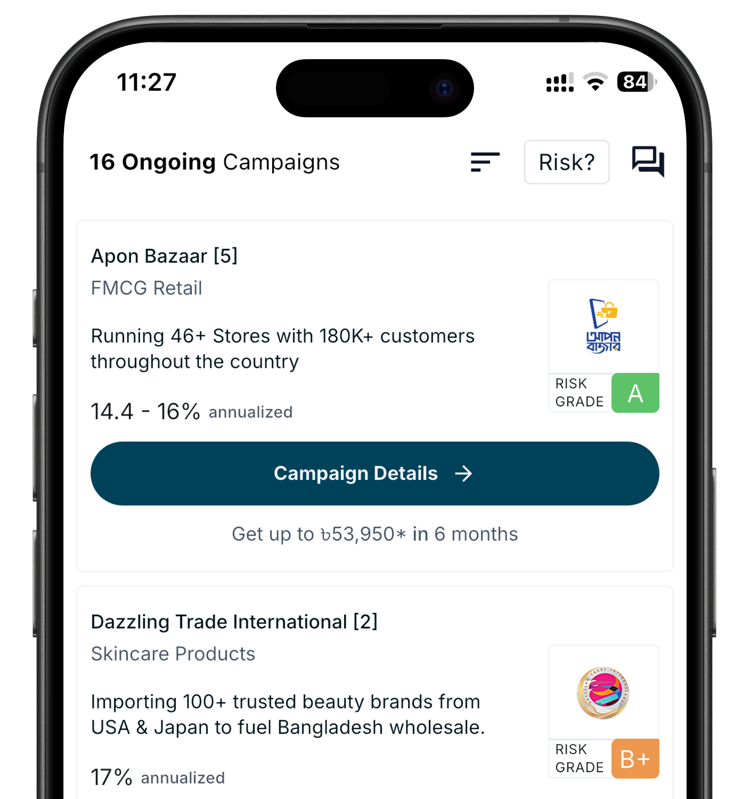
At biniyog.io, our mission is to make it simple to put these principles into actual practice. We offer shariah-compliant investment options, transparent risk grading, real businesses, real risk-sharing, starting from as little as ৳5,000. Because we don’t want halal finance to be complicated, but rather we want to make it mainstream for people from all walks of life.
Wealth earned in honesty, spent in moderation, shared with open hands, and grown through genuine risk-sharing is the wealth that carries barakah. Not just financial security, but the kind that settles the heart in this life and follows you into the next.
For any questions, leave us a message or contact our support.
Your financial well-being is our topmost priority & our team is always here to help. Visit biniyog.io or reach out to our support team.
DOWNLOAD OUR APP
Start your journey to wealth.
Our halal investments are structured in accordance with the strictest Islamic principles.


Office Level 5, House 60, Kazi Nazrul Islam Avenue, Dhaka 1215
Contact +880 1886 064 046


