

5 HABITS QUIETLY
DRAINING YOUR SALARY
Every month, when your salary comes in, it feels like enough when you take a look at it. But then, somehow, a few weeks later you're back to counting what's left of it. And every month, you don’t face it because of any one big expense, but because of a hundred small ones that had no particular plan behind them.
This happens across income levels, across professions, across cities. It isn't really a money problem. It's a direction problem. And the first step to fixing it is recognizing the exact patterns that are quietly draining every paycheck before it ever gets a chance to work for you.
Here are five of the most common ones, and more importantly, what to do instead.
1. SPENDING WITHOUT A PLAN AND HOPING THE MONEY FIGURES ITSELF OUT
The most widespread financial approach in Bangladesh isn't really an approach at all. It's a hope. We hope we will spend on what's needed, try not to overspend, and assume that discipline alone will make it work. No categories, no set limits, no real awareness of where the month’s salary went until it's already gone.
Imagine a mid-level executive in Mirpur earning ৳55,000 a month. It's a decent income by most measures. But with no monthly structure in place, that salary quietly disappears into online purchases, weekend outings, impulse buying, and informal expenses. None of them feel large in the moment, but they add up to nearly everything by the end of the month. It's not recklessness. It's just the absence of a plan.
A spending plan doesn't need to be rigid or complicated. It just means deciding, before the money arrives, where different portions of it are going. That one decision changes almost everything that follows.
What to do instead
Assign your income to categories before the month begins. Categories could include essentials, savings, family commitments, discretionary spending, etc. Even rough percentages give your money a direction it wouldn't find on its own.
2. YOU PAY EVERYONE BEFORE YOU PAY YOURSELF
The standard approach goes like this: income comes in, bills get paid, commitments get met, contributions go out, spending happens. And if anything remains at the end, it gets set aside. In theory, this sounds responsible. In practice, something almost always absorbs whatever was supposed to be left over.
A pharmacist in Sylhet earning ৳38,000 has rent, utilities, his daughter's coaching fees, and monthly contributions to his mother's household. By the time all of that settles, the "I'll save what's left" intention has no room to land. It isn't because he doesn't value saving; it's because saving was given the least protected slot in his entire financial week.
The Prophet ﷺ said: "The upper hand is better than the lower hand" - referring to the one who gives rather than the one who receives (Sahih al-Bukhari 1429). Financial self-sufficiency isn't selfishness. It is the foundation that allows you to keep giving. Securing your own financial stability first means you'll never become a burden on others, and you'll always have something to offer.
What to do instead
Set aside your savings the moment income arrives before any spending begins. Treat it like a bill you owe yourself. What doesn't get touched first doesn't get spent first.
3. WITHOUT ANY CUSHION, YOUR NEXT EMERGENCY BECOMES SOMEONE ELSE'S INTEREST RATE
There's a specific kind of financial disaster that has nothing to do with bad decisions and everything to do with bad timing. It could be a medical bill, a sudden repair, a lost month of work, or any kind of emergency arriving exactly when you're least ready for it.
A motor-garage mechanic in Bogura has never quite managed to put anything aside. Each month's income gets absorbed before the next one starts. When his father suddenly needs surgery costing ৳65,000, there's nothing to draw from. He borrows from a local mohajon at a steep monthly rate, fully intending to clear it in a few months. A year later, the interest has grown faster than his repayments could shrink it, and he's still paying down a debt that keeps regenerating itself.
This is exactly why the Qur'an tells the story of Prophet Yusuf (peace be upon him) advising Egypt to store grain through the fertile years specifically so the lean years wouldn't wipe everyone out (Surah Yusuf, 12:47–48). The emergency itself wasn't the failure. Arriving at it with nothing set aside was.
What to do instead
Keep 3–6 months of core expenses somewhere liquid and untouched for emergencies only. It isn't investment money. It's what keeps a mohajon out of the picture entirely.
4. LETTING YOUR MONEY IS SIT STILL WHILE PRICES KEEP MOVING
Most Bangladeshi households treat a savings account as the finish line of financial responsibility. The habit of setting money aside is genuinely good. The assumption that it's growing while it waits is one of the most expensive misunderstandings in personal finance.
A nurse at a private hospital in Chattogram has put ৳4,000 a month into her current account for three years. This resulted in ৳1,44,000 accumulated. She feels responsible, and she should. What she doesn't feel is inflation, which has run above 10% for two years straight, quietly eating into what that ৳1,44,000 can actually buy. Her number grew. Its real worth didn't.
Umar ibn al-Khattab (RA) advised: "Invest the wealth of orphans so that it is not eaten away by zakat." Idle wealth is not only financially unproductive in Islam, but it's also subject to zakat at 2.5% annually. Money that simply sits still faces an implicit cost in both worlds.
What to do instead
Current accounts are for liquidity and emergencies. The money beyond that safety net belongs somewhere that actually works, ideally in real, halal, productive activity that returns more than inflation takes.
5. WAITING FOR "ENOUGH INCOME" TO START AND WATCHING THE BEST YEARS PASS
One of the most quietly devastating financial decisions people make isn't a bad investment, it's the decision to wait. I'll start properly when I earn more. When the kids finish school. When things settle down. It always sounds reasonable. And it always costs more than people realize.
A teacher in Rajshahi earning ৳32,000 has built a decent cushion in her savings account and feels she's done the responsible thing. She's not wrong but she's also not finished. Saving protects what you already have from a bad month. On its own, it does almost nothing to grow it. Those are two separate jobs, and treating one as a stand-in for the other is how a healthy-looking balance still isn't real wealth ten years later.
Saving protects your capital. Investing is what grows it. Skipping the second one isn't caution; it's leaving the job half-finished.
The Prophet Muhammad (peace be upon him) praised the deed that is small but done consistently over the one that is occasional but large (Sahih al-Bukhari, 6465). The same logic holds here: a coordinator who moves even ৳5,000 a month from savings into real investment at 24 will very likely end up ahead of someone who waits until 38 to start with ৳30,000 because consistency and time outwork the size of any single amount.
What to do instead
Once your emergency fund exists, treat everything beyond it as investable - even a small, steady amount. Save for protection first. Then invest what's beyond that, for growth.
FINAL THOUGHTS
None of these five habits need a bigger salary to fix, and none of them are personal failures. They're patterns, repeated across millions of households, that quietly cancel out financial effort before anyone even notices it happening.
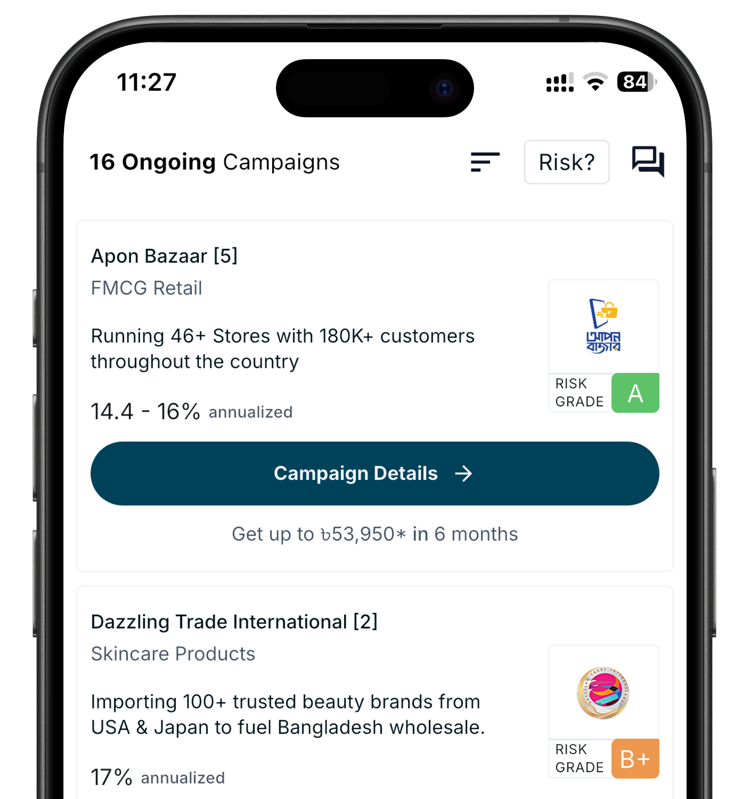
They're also, not by coincidence, close to a checklist of exactly what biniyog.io was built to solve. Habits 1 and 2 are about giving your money a job before it disappears. biniyog lets you start directing a slice of every paycheck into real investment from as little as ৳5,000, so "I'll invest what's left" stops being the plan. Habit 3 is about protection existing before it's needed. Our Investor Protection Pool exists so that a hard month never has to end with a trip to a mohajon. Habit 4 is about money that actually works. Every taka on biniyog goes into real Bangladeshi SMEs through Shariah-compliant structures, not a static number quietly losing ground to inflation. Habit 5 is the bridge most advice never finishes building, from saving to investing. And that bridge is essentially the entire reason biniyog exists, built for starting small and growing steadily.
Barakah follows intention, and intention starts with whatever today actually has in it, not the salary you're hoping to earn next year.
For any questions, leave us a message or contact our support.
Your financial well-being is our topmost priority & our team is always here to help. Visit biniyog.io or reach out to our support team.
DOWNLOAD OUR APP
Start your journey to wealth.
Our halal investments are structured in accordance with the strictest Islamic principles.


Office Level 5, House 60, Kazi Nazrul Islam Avenue, Dhaka 1215
Contact +880 1886 064 046


