
Shariah Finance 102
A Practical Guide on How to Start Halal Investing in Bangladesh
If you've ever wanted to invest your money but felt unsure where to start, you're not alone. Bangladesh has a huge number of investment options available, but the landscape is messy. Most businesses in the country are genuinely operating in the halal sectors since the majority are usually small shops, garment suppliers, agro businesses, manufacturers, tech startups, etc. But mixed in with the legitimate opportunities are a growing number of fraudulent schemes that have already cost Bangladeshis tens of thousands of crore taka.
On top of that, if you specifically want to invest the halal way, the challenge doubles. You need to check whether a business/specific project is profitable and whether the investment meets Shariah standards. Without proper knowledge, both of those checks are hard to do on your own.
This guide explains what halal investing actually means in the Bangladeshi context, what the market actually looks like, and how to build a simple, trustworthy investment habit step by step.
What is Halal Investing and Why Does it Matter:
Halal investing means putting your money into ventures that are permissible under Islamic principles. It's an ethical approach that filters out mainly two things: businesses involved in harmful activities for society, and financial structures that rely on interest (riba).
In an Islamic framework, money should only grow when it's connected to something real. It could be a product, a service, a business that actually generates value. Your gain should be tied to genuine economic activity, and your risk should be shared with the person or business you're financing.
In Bangladesh, this matters for a very crucial reason: roughly 90% of the population is Muslim, yet the vast majority of traditional available products we consider to be "investment" are bank FDs, DPS, Bonds, etc. The one common thing between all of them is that they are all structured around interest. Many people either avoid investing entirely out of uncertainty, or invest in conventional products while feeling guilty about it. Neither outcome is good for anyone’s personal financial health.
Here's the good news: Bangladesh already has a large halal-friendly economy. Most of the businesses that you see around you are genuinely permissible to invest in. The challenge isn't finding halal businesses. It's finding a trustworthy, transparent way to invest in them.
Why You May Struggle to Invest Directly in a Business:
Since most businesses in Bangladesh are halal, the simplest idea is to invest in them directly. Put money into a neighbour’s garment unit, a trader you know, or a friend’s startup. In theory, that’s exactly how Islamic finance is meant to work. In practice, a few things get in the way.
You have to do all the assessment yourself. Is the business actually profitable? Is the owner trustworthy? Are the documents real? What is their profit and loss situation? Are the numbers they claim verifiable? What will be the terms of the contract? Is the contract structured in a Shariah-compliant way? For a common man navigating everyday life, these are hard questions to answer, and solely relying on guesswork and a wrong answer costs you real money.
You can’t be at peace about where your money goes. Once you hand over your money, how do you know it’s being utilized only in the activities according to the contract, and in the business you were told about? Monitoring that yourself means constant follow-ups, visits, and paperworks. Most people simply can’t do it, so they end up just hoping for the best.
You’d need a large amount of capital. Most businesses looking for direct investment need lakhs, not thousands. If you only have ৳5,000 or ৳10,000 to start with, direct investment is out of reach.
You can’t diversify easily. Spreading your money across several businesses is the most basic risk management technique ever. But if every business needs a big ticket size, diversifying needs a big pool of money. Without it, all your savings end up sitting in one or two businesses, and if one of that has a bad year, so do you.
Put together, investing the halal way directly on your own means a lot of hassle: finding businesses, verifying them, structuring the contract, tracking repayments, and following up if something goes wrong. That’s exactly why platform like biniyog that does this heavy lifting for you have started to emerge.
Step-by-step guide to Halal Investing:
Here's how to start building a halal investment habit from scratch.
1. Understand what you're actually investing in
Before anything else, understand the business behind your investment. Is your investment tied to a genuine activity? Or is it just raising money? This is especially important in Bangladesh, where front companies and fraudulent schemes have repeatedly posed as genuine businesses.
Two questions to ask about any investment:
1. What does this business actually do? Can you understand its revenue and the business model? If not, that's a problem.
2. Is the sector permissible? Avoid businesses involved in alcohol, tobacco, gambling, adult entertainment, or illegal trade of any kind.
There is however a documented problem in our nation where some businesses operate as legitimate fronts. There are even some noteworthy ones with valid RJSC registration while running Ponzi structures or concealing illegal activities underneath. The MTFE scam, which disappeared with an estimated Tk 20,000 crore of investor funds in 2023, described itself as a metaverse and crypto trading company. It had professional branding, "CEO" ranks, and a structured payout system. None of that made it real.
A business being registered doesn't mean it's honest. We need to see how it actually makes money. Spotting the difference takes time, documents, and trained eyes, which is the part most individual investors don’t have the means to do alone.
Source: Dhaka Tribune
2. Check for Shariah compliance
Once you've confirmed a business is legitimate, check whether the contract structure is halal. Two main things to look at:
Business activity: Is the core product or service permissible? If yes, proceed.
Financial structure of the investment: Does the investment involve fixed interest, or does it share in actual profit and loss? Or is it a genuine buy-and-sell in a deferred payment structure? A genuine halal investment will never promise you a risk-free guaranteed fixed return regardless of the business outcome.
For the stock market specifically, the Dhaka Stock Exchange has a DSEX Shariah Index which is a screened list of listed companies that meet Islamic finance criteria. As of early 2025, around 39% of DSE-listed companies are considered Shariah-compliant. However, the stock market remains a complex maze where regular people with low financial knowledge tend to suffer a lot due to not understanding how things actually work.
Source: Traders Union
3. Define your investment goal and timeline
Before choosing where to invest, be clear about why you're investing. Your goal shapes everything: the type of investment you choose, the amount of risk you can reasonably accept, and how long you should leave your money in.
Short-term goal (under 1 year): You can start with this and some of the portfolio should belong here. It should stay more liquid and low-risk, easy to reach the moment you need it. Money you don’t need for a few months, can work in a short-tenure investment, as long as you’re sure you can leave it untouched until the tenure ends. You should consider diversifying smartly, because there are always risks involved in an investment.
Medium-term goal (1-5 years): This could be the fund you are saving for launching a business, putting down a deposit, or planning for your child's education in the next few years. You can use this fund to take on a little more risk in exchange for better returns.
Long-term goal (5+ years): This is usually the fund you create for retirement, wealth-building and your investment portfolio. This is where compounding does its best work. For this you need to start as early as possible.
A practical starting point:
You should never invest your emergency funds or money that you might need within the next few months. Halal SME investments on platforms like biniyog.io have defined tenures which are typically 3–12 months. Therefore, your money should be something you can genuinely set aside for that period. Always keep your emergency cushion separated.
4. Choose a platform you can actually trust
This is where Bangladesh differs significantly from developed markets like the US. In the US, mainstream brokers are heavily regulated, and even conventional platforms carry significant legal accountability. In Bangladesh, the regulatory environment for alternative investments is still developing; this means the platform you choose carries enormous weight.
A good platform should take the hassle off your shoulders. It should vet the businesses, structure contracts in a Shariah-compliant way, keep an eye on how the money is used, and let you start small and still diversify.
When evaluating any investment platform, ask:
- Who runs it, and can you verify their identity and track record?
- Is there a Shariah advisory board, and is it independently certified? Or is it just a mere halal tag?
- Does the platform conduct physical due diligence on the businesses it lists?
- What is the nature of the investment? Does it really exist and tie to real economic activities?
- Are the fees clearly stated, with nothing hidden?
Unlike the stock market, which requires you to open a BO account, find a broker, and navigate the DSE yourself, some platforms eliminate that layer entirely. biniyog.io, for instance, lets you invest directly in pre-vetted SME campaigns through the app without needing a broker or brokerage account at all. This makes the process significantly more accessible, especially for first-time investors.
5. Diversify across multiple investments
Never put everything into a single business or a single type of investment. Diversification is a basic principle of managing risk, and it's available to you even with a small starting amount.
- Spread across different businesses and categories: one agro-business, one trading company, one manufacturing SME, one lifestyle retailer, etc
- Spread across different risk grades: a mix of lower-risk Grade A and higher-return Grade B campaigns
- Spread across different durations: some short-tenure, some longer, so your capital doesn't all lock up at once
You don't need large amounts to diversify. Investing ৳5,000 each across four different campaigns is genuinely diversified and wiser than putting ৳20,000 into a single one.
Doing the same through direct deals would mean finding and assessing four separate businesses willing to take small amounts, which rarely happens. This is one of the biggest advantages of investing through a platform like biniyog.io.
6. Review regularly and stay informed
An investment isn't something you set and completely forget. Stay connected to what your money is doing:
- Check campaign updates when they're posted
- Read repayment notifications and understand any delays
- Keep building your financial knowledge. The more you understand, the better your future investment decisions will be
If you're investing in DSE stocks, compliance status, a major news can change as a company's financials shift. So, review your holdings periodically against the DSEX Shariah Index or a trusted screening platform.
How to Invest Using biniyog.io:
Starting on biniyog.io is straightforward and easy. Here's the process from download to your first investment.
1. Download the app
Available on both Android (Google Play) and iOS (App Store). Search "biniyog" or visit biniyog.io/download.
2. Create your account Sign up with your mobile number. Complete the basic KYC process. Your identity and account details are kept secure.
3. Browse active campaigns
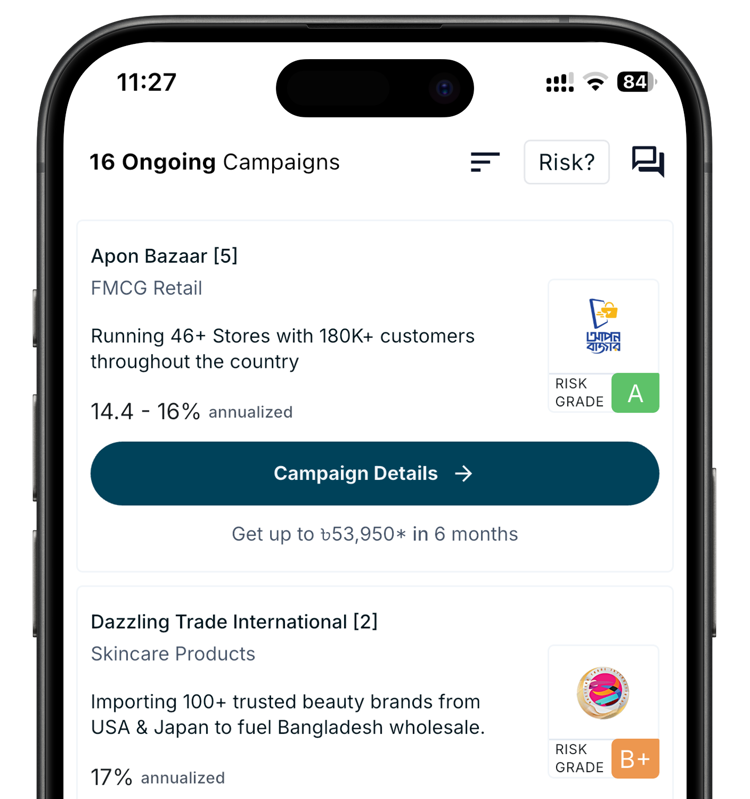
Each campaign on the app shows you the business type, its risk grade (A, B+, or B), the expected profit rate, the tenure, and detailed information about the business, its owner, the risks involved and the contract. Read everything before deciding.
4. Decide how much to invest The minimum investment per campaign is ৳5,000. You can invest in multiple campaigns at once. Only invest money you can genuinely set aside for the campaign's full duration.
5. Complete your investment
Transfer your funds through your preferred MFS or your bank account and upload the payment proof. Your investment goes into the campaign accordingly, there are no hidden charges. The numbers you see in your contract details and authorization contract are the exact ones.
6. Track repayments
Monitor your active investments and repayment status from My Portfolio & Repayment Schedule section of the app. According to the contract and repayment schedules, your principal and profit share are returned to your account.
What is Halal Investing and Why Does it Matter:
Here's what sets the platform apart for Bangladeshi investors specifically.
1. Certified Shariah compliance:
You don’t have to work out on your own whether a contract is Shariah-compliant. biniyog.io is the first fintech in Bangladesh with Shariah compliance certification from internationally recognized AAOIFI-certified scholars, not just a self-declared label.
2. Real due diligence:
You don’t have to investigate every business yourself. Every business on the platform is physically verified and assessed across 40+ criterias like financials, documents, business health, owner’s track record, etc before it's listed.
3. Transparent risk grading:
Campaigns are graded A, B+, or B so you can make informed decisions about the risk you're comfortable taking. Nothing is hidden.
4. No broker needed:
Unlike stock market investing, you don't need a BO account or a licensed broker to invest in our SME campaigns. Open the app, choose a campaign, and invest. That's it.
5. Protection & support:
You don’t have to chase a business alone if something goes wrong. If a repayment is delayed, biniyog's team investigates, consults Shariah advisors, and if necessary, pursues legal recovery on investors' behalf. The team also provides a Shariah-compliant takaful-based safety net through the Investor Protection Pool.
6. Start from ৳5,000:
You don’t need lakhs to start, and you can still spread your money across multiple businesses. A small, consistent start, diversified across multiple campaigns, beats waiting for the “right amount.”
What is Halal Investing and Why Does it Matter:
Halal investing means putting your money into ventures that are permissible under Islamic principles. It's an ethical approach that filters out mainly two things: businesses involved in harmful activities for society, and financial structures that rely on interest (riba).
In an Islamic framework, money should only grow when it's connected to something real. It could be a product, a service, a business that actually generates value. Your gain should be tied to genuine economic activity, and your risk should be shared with the person or business you're financing.
In Bangladesh, this matters for a very crucial reason: roughly 90% of the population is Muslim, yet the vast majority of traditional available products we consider to be "investment" are bank FDs, DPS, Bonds, etc. The one common thing between all of them is that they are all structured around interest. Many people either avoid investing entirely out of uncertainty, or invest in conventional products while feeling guilty about it. Neither outcome is good for anyone’s personal financial health.
Here's the good news: Bangladesh already has a large halal-friendly economy. Most of the businesses that you see around you are genuinely permissible to invest in. The challenge isn't finding halal businesses. It's finding a trustworthy, transparent way to invest in them.
FINAL THOUGHTS
Halal investing in Bangladesh doesn't need to feel out of reach. The country has a large base of genuinely permissible businesses, a growing ecosystem of Shariah-compliant financial products, and finally, platforms like biniyog.io that do the heavy lifting so you don't have to.
Investing directly in businesses is possible, but it takes large capital, constant monitoring and a lot of expertise. Most people have none of the three, and that’s exactly the gap good platforms exist to fill.
The main things to remember: keep your emergency funds aside, understand what you're actually investing in, avoid anything that promises returns too good to be true, diversify even when your amounts are small, and choose a platform you can genuinely trust.
Your money can work for you ethically. It just needs to be pointed in the right direction.
We wish that your investment journey is filled with barakah.
For any questions, leave us a message or contact our support.
Your financial well-being is our topmost priority & our team is always here to help. Visit biniyog.io or reach out to our support team.
DOWNLOAD OUR APP
Start your journey to wealth.
Our halal investments are structured in accordance with the strictest Islamic principles.


Office Level 5, House 60, Kazi Nazrul Islam Avenue, Dhaka 1215
Contact +880 1886 064 046


