
WILL HALAL INVESTMENTS LOWER MY RETURNS?
Written by Miftaha Hossain Chowdhury & Nawshad Kabir Ananda
22 November 2026 · 11 min read
Afraid That You’ll Get Lower Returns from Halal Investments?
Let's be honest about a belief that many Bangladeshi investors quietly carry: “If I stick to halal investments, am I leaving money on the table?”
It's a fair question, and it deserves a serious answer. In Bangladesh, conventional investment options like bank fixed deposits, DPS and bonds have existed for decades, are widely trusted, and come with clearly stated returns with a perception of zero risk. The halal alternative, in comparison, can feel newer, less certain, and harder to verify. And there's a deeper fear underneath all of this, one that we have all heard at some point: “What if the "halal" label is just riba repackaged with different terminology?”
This blog will help you overcome that fear so that you can finally start your halal investment journey.
The Fear Is Real and Rooted in Something True
The skepticism Bangladeshi Muslims feel toward Islamic financial products isn't unfounded. A Research conducted in 2017, published in the American International University Bangladesh (AIUB) journal found that a significant portion of the Bangladeshi population believes that profit-sharing mechanisms used by Islamic banks are, in practice, just a different name for the same conventional interest. They think it's riba with a renamed label.
And to be fair, that criticism has had genuine targets. Some Islamic banks in Bangladesh have faced scrutiny from scholars and regulators for structuring products in ways that closely mirror conventional interest arrangements rather than genuine profit-and-loss along with risk sharing. The confidence crisis that struck several of Bangladesh's largest Islamic banks between 2022 and 2024, marked by loan irregularities and sustained deposit withdrawals, only deepened public suspicion about whether "Islamic" in a product name actually means anything.
So the concern isn't irrational. The important thing is to know what to look for, because the problem has never been with the Islamic finance contracts themselves. It has been with their inconsistent and sometimes dishonest implementation.
Sources:
AIUB Journal on Islamic Banking in Bangladesh: American Journal of Business and Economics, AIUB. Islamic bank confidence crisis 2022–2024: Journal of Islamic Economic Insights, 2025.
What Islam Actually Says About Your Returns
The fear that choosing halal will shrink your sustenance is, at its core, a question about whether Allah's promise holds up in financial reality. The Qur'an addresses this directly.
وَمَن يَتَّقِ اللَّهَ يَجْعَل لَّهُ مَخْرَجًا وَيَرْزُقْهُ مِنْ حَيْثُ لَا يَحْتَسِبُ
"And whoever fears Allah, He will make for him a way out, and provide for him from sources he could never imagine."
- Qur'an, Surah At-Talaq [65:2–3]
The concern that often follows this verse is: “Yes, but does that promise apply to investment returns in a real market?” The hadith answers that too.
اتَّقُوا اللَّهَ وَأَجْمِلُوا فِي الطَّلَبِ فَإِنَّ نَفْسًا لَنْ تَمُوتَ حَتَّى تَسْتَوْفِيَ رِزْقَهَا
"Fear Allah and seek your provision in a good manner, for no soul shall die until it has received all of its provision, even if it is slow in coming. So fear Allah, seek your provision in a good manner, and take what is permissible and leave what is forbidden."
- Sunan Ibn Majah, no. 2144 · sunnah.com/ibnmajah:2144
This isn't a promise that halal investing will make you rich overnight. It's something more fundamental: your full provision is already decreed. The question isn't whether you'll get it; it's whether you'll pursue it through means that are clean or means that carry consequences. Choosing the halal path doesn't reduce your rizq. It determines the condition it arrives in.
Now Let's Look At The Actual Numbers
Spiritual conviction is important. But if you're wondering whether halal investments can genuinely compete with conventional alternatives on returns, that's a practical question, and it deserves a practical answer.
In Bangladesh today, your conventional options are roughly: bank fixed deposits or DPS at 6–8% annually, and Sanchayapatra at around 9.72–11.98%. Against an inflation rate that has been running above 10% for much of 2024 and 2025, both of these produce a near-zero or negative real return. You are earning a number that feels like growth while your actual purchasing power quietly declines.
Halal SME investments, the kind available through biniyog.io, target profit rates that reflect what real businesses actually generate. These vary by campaign and risk grade, but they're tied to genuine economic activity rather than just committed profit numbers regardless of outcome. The returns are subjected to investment risk, not 100% guaranteed (and any platform that guarantees them is a red flag, halal or otherwise), but they are linked to something real.
A direct comparison:
The question isn't "halal vs. conventional" in some abstract moral sense. It's: would you rather earn a fixed 6–8% on a bank product while inflation at 10% erodes your real wealth, or would you accept a variable return from a verified business that is actually generating revenue? The second option carries more disclosed risk. It also carries the possibility of meaningfully positive real returns, and it doesn't come at the cost of your afterlife. If you invest & diversify smartly, investment risks can also be mitigated to a greater extent.
Sources:
Sanchayapatra rates 9.72–11.98%: RTV Online. Bangladesh inflation rate exceeding 10% in 2024–2025: Statista. Deposit rates ~6–8%: The Business Standard.
"But how do I know it's actually halal and not just riba with a different name?"
This is the most important question in this entire article. And the honest answer is: you can't take the label at face value. You have to look at the structure.
Genuine halal investment has a few distinguishing features that separate it from riba in a different label:
Real risk-sharing: In a genuine Islamic investment contract, whether Mudarabah (profit-sharing) or Musharakah (partnership), the investor shares in the business's actual profit and actual loss. In the case of Murabaha (buy-and-sell contract), the investors also share the risk of potential delays in repayment from the businesses and potential damage, theft, loss of purchased products before handover. The return isn’t something that will be paid regardless of outcome, Islam doesn’t allow any party to commit zulm in the deal. If the business struggles, the return reflects that. This is fundamentally different from an interest-bearing product, where the bank pays you a fixed rate at a fixed time whether or not it uses your money productively tied to a real economic activity.
An independently verified Shariah board. A platform or product that is genuinely Shariah-compliant will have its contracts reviewed and certified by qualified Islamic scholars and will not just declare themselves compliant by its own marketing team. The gold standard for this is certification from AAOIFI (Accounting and Auditing Organisation for Islamic Financial Institutions), the internationally recognized Shariah governance body.
Transparent contracts you can actually read. Before investing in any campaign, you should be able to read the contract structure, understand what type of Islamic finance instrument is being used, potential risks, and ask questions about it. If a platform discourages these questions, claims zero risk, guaranteed returns, or makes the structure hard to access, that is a warning sign.
On biniyog.io's certification:
biniyog.io is the first fintech in Bangladesh to receive Shariah compliance certification from IFA Consultancy, a reputed institution consisting AAOIFI-certified CSAA scholars. AAOIFI is the globally recognized standard-setting body for Islamic financial institutions. This is not a self-declaration. It is an external verification of the contracts, structures, and processes used on the platform. Every campaign (Campaign = individual fundraising offering from businesses in biniyog platform) before launch has been reviewed against Shariah principles by qualified scholars, not solely biniyog team. If you want to read the details of how biniyog's contracts work and why they are considered Shariah-compliant, we encourage you to do exactly that. Our Shariah page is available at biniyog.io/shariah.
Source:
AAOIFI (Accounting and Auditing Organisation for Islamic Financial Institutions) is the Bahrain-based international body that sets Shariah standards for Islamic finance globally. More information: aaoifi.com.
So What Should You Actually Do?
Don't just trust a label. Study the product. This applies to biniyog.io just as much as it applies to any Islamic bank or takaful provider. Here's what to look at:
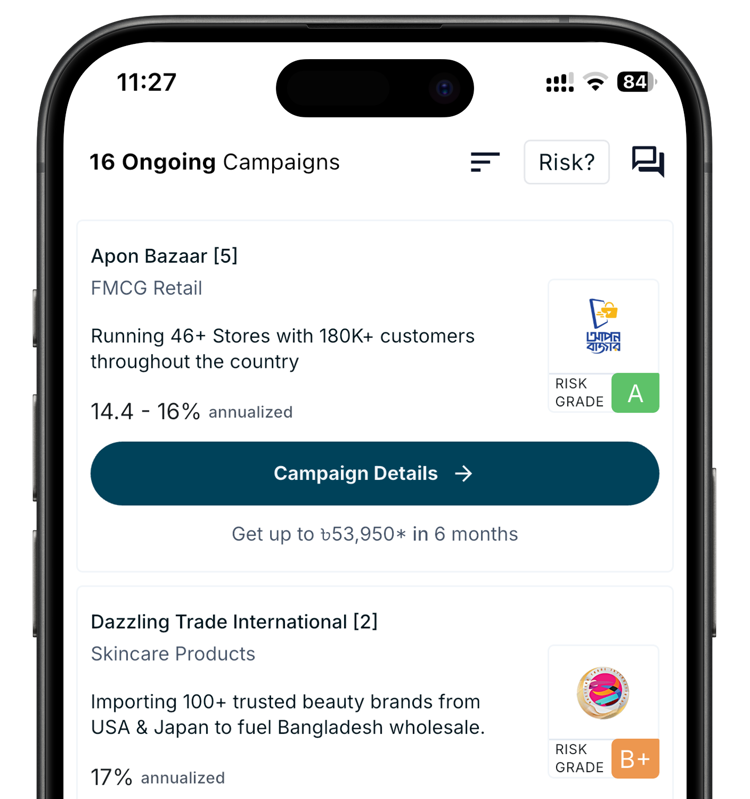
Read the campaign details. Each campaign on biniyog.io tells you what the business does, how it generates revenue, what the financing structure is, and what the risk grade is. That information exists so you can make a judgment.
Understand the contract type. Is it Mudarabah? Musharakah? Murabaha? or anything else? What does that mean for how returns are calculated and how risk is shared? If you don't know yet, you can read in detail about each kind of deal under the contract section before investing.
Ask questions. Our team is reachable on [email protected] and +880 1886 064 046. If something in a campaign description is unclear or you want to understand how the Shariah compliance actually works in practice, ask. A platform you can question is a platform you can trust.
Blind faith in a halal label isn't taqwa, it's unwise. Real taqwa in investing means understanding what your money is doing, carrying a shared risk, and ensuring it genuinely aligns with your values, not just your assumptions.
FINAL THOUGHTS
The fear that halal investing means lower returns is understandable, but it rests on a false premise. The real choice isn't between halal and high returns. It's between returns that are tied to genuine, real economic activity; risk-sharing in a real business; and returns that come from an interest-based structure that erodes purchasing power while feeling safe.
Allah ﷻ does not hold back your sustenance when you choose the honest path. What He asks in return is that you pursue it properly, with knowledge, with discernment, and with the willingness to ask hard questions rather than assume a label is enough.
If you're still uncertain, the right response isn't to avoid halal investing. It's to study it until you're no longer uncertain anymore.
We hope your halal investment journey will be free from confusion and bring actual barakah to your life.
If you’re interested to know more about how biniyog.io maintains Shariah Compliance in each type of contract, here’s an easy to understand infographic series published earlier in biniyog’s social media:
For any questions, leave us a message or contact our support.
Your financial well-being is our topmost priority & our team is always here to help. Visit biniyog.io or reach out to our support team.
DOWNLOAD OUR APP
Start your journey to wealth.
Our halal investments are structured in accordance with the strictest Islamic principles.


Office Level 5, House 60, Kazi Nazrul Islam Avenue, Dhaka 1215
Contact +880 1886 064 046


